
Iceland straddles the Mid-Atlantic Ridge, where the North American and Eurasian plates pull apart and magma sits unusually close to the surface. The practical consequence is hot water almost everywhere: around nine in ten Icelandic homes are heated geothermally, and bathing in naturally heated water is not a tourist activity here but an ordinary part of the week. Understanding the four tiers of Icelandic bathing will save you money and get you somewhere better than the queue.
Developed spas
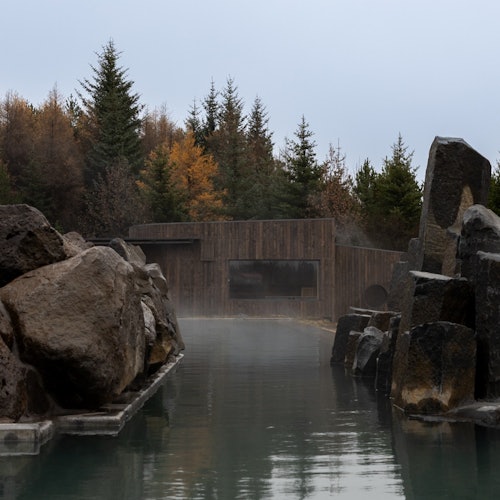
These are the destination baths: designed architecture, changing rooms, bars, timed entry and prices to match. The Blue Lagoon on Reykjanes and Sky Lagoon just outside Reykjavík are the two flagships, but the network now covers most of the country.
Mývatn Nature Baths gives you the same mineral-blue water as the Blue Lagoon with a view across the northern lake district and far fewer people. Vök Baths near Egilsstaðir has floating pools set into a lake in the east. GeoSea in Húsavík looks out over the bay where the whales are. Krauma in the west is fed by Deildartunguhver, the most powerful hot spring in Europe by flow rate. Almost all require booking ahead in summer.
Municipal pools: the real Icelandic experience
Every town of any size has a sundlaug — a geothermally heated public pool complex — and this is where you will meet actual Icelanders. Entry costs a fraction of a spa ticket. You get a lap pool at around 28°C, several hot pots at graduated temperatures from roughly 38°C to a scalding 42°C, usually a steam room or sauna, and often a cold plunge.
In Reykjavík, Laugardalslaug is the largest, Vesturbæjarlaug is the neighbourhood favourite, and Sundhöllin is a beautifully restored 1937 indoor pool with a rooftop terrace. The hot pot is a social institution — this is where local politics, gossip and complaints about the weather get processed. If you do one thing to understand Iceland, do this.
Natural and semi-natural pools
Then there is the free stuff, which ranges from a concrete pool someone built a century ago to a warm river you have to walk to.
- Reykjadalur, above Hveragerði on the Golden Circle route, where a roughly three-kilometre uphill hike brings you to a river warm enough to lie in. There are boardwalks and screens; different stretches run at different temperatures, so walk up until it feels right.
- Seljavallalaug, tucked into a valley off the south coast near Skógar. Built in 1923 and among the oldest pools in the country, it is fed by a hot spring through a pipe, free to use, and cleaned only occasionally — so expect algae and basic changing huts.
- Landmannalaugar in the highlands, where a natural pool sits at the edge of a lava field beside the campsite. Accessible only in summer, and only by 4x4 or highland bus.
- Krossneslaug on the remote Strandir coast in the Westfjords, a pool built right beside the ocean with nothing but the Arctic in front of it, and the free roadside hot pots at Drangsnes across the road from the sea.
- Hrunalaug near Flúðir, a tiny stone-walled pool on private farmland where the owners ask a small contribution for upkeep.
Safety: this is genuinely important
Geothermal water in Iceland reaches boiling and beyond. People have been very seriously burned, and some have died. Never enter water you have not been told is safe, never step off marked paths in geothermal areas such as Hverir, Seltún or the Geysir field, where a thin crust can conceal boiling mud, and never let children or dogs run loose there.
Grjótagjá near Mývatn is the cautionary example: a beautiful lava cave with a hot spring that was a popular bathing spot until eruptions in the 1970s pushed the water temperature far too high. It sits on private land and bathing is not permitted. Look, photograph, do not get in.
Test unfamiliar water with a hand before committing, and be aware that hot springs stratify — the surface can be pleasant while the layer beneath is not.
Etiquette
One rule matters above all others: before entering any pool, spa or hot pot in Iceland, you must shower thoroughly and completely naked with soap, in the communal shower area. Icelandic pools use minimal chlorine because the water is constantly renewed, and this hygiene rule is what makes that possible. It is signposted in several languages, attendants enforce it, and skipping it is the fastest way to be publicly told off in a country that is otherwise extremely relaxed.
Beyond that: keep your voice down in the hot pots, take glass nowhere near the water, follow the posted maximum soak times in the hottest pools, and at natural sites leave absolutely nothing behind. Several free pools have come close to being closed by landowners because of litter and human waste. Treat them as somebody’s property, because they usually are.
Skip the queue
Lagoon & hot spring tickets

Reykjavík
Sky Lagoon: Entry Ticket
Relax in thermal waters and enjoy views of the surrounding landscape
★ 4.8 (760)
from €106.22

Grindavík
Blue Lagoon: Entry Ticket
Soak in the benefits of thermal waters in Iceland
★ 4.4 (118)
from €131.88

Laugarás
Laugarás Lagoon: Entry Ticket
Soak in warm geothermal water and dip into a cold pool
★ 5.0 (11)
from €57.91
Laugarás
Laugarás Lagoon: Premium Entry
Unwind in warm geothermal waters and enjoy a drink
from €84.30
We may earn a commission if you book, at no extra cost to you. Learn more · Prices may change.
Where to stay
Places to stay near Reykjavík
Compare hotels, guesthouses and cabins across Booking.com, Expedia, Vrbo and more. Book early in summer: rooms outside Reykjavík sell out.
We may earn a commission if you book, at no extra cost to you. Learn more
Before you go
Rent a car & travel essentials
Loads the full Localrent catalogue with prices, photos and filters.
Stay online
Get a Saily eSIM before you fly: mobile data from the moment you land, no SIM swap or roaming bill.
Get an eSIM →Travel insurance
Cover for cancellations, medical costs and gear, for trips with glaciers, volcanoes and winter roads.
Get a quote →
We may earn a commission if you book, at no extra cost to you. Learn more

Written by
Erika Sand
Erika has spent the last decade driving, hiking, and hot-spring-hopping across Iceland in every season. She writes NRF.is’s itineraries, guides, and trip reports to help travelers see the country safely, affordably, and without the tourist-trap detours.